


A "Discussions" facility has been added for Q&A etc. Use the "Issues" tab only for problems with the library. Thanks!
I have setup a Ko-fi account so you can "buy me a coffee!" This encourages me to add new features and capabiities to TFT_eSPI.
-
The ESP32 S3 DMA capability now works with ESP-IDF versions greater than 2.0.14. This has been tested with the Arduino 3.3.6 board package. ChatGPT gave me a clue for the change (use SPI_DMA_CH_AUTO for the register selection) but the AI generated response did contain duff info regarding some (mostly harmless) register bit settings needed!
-
The Create_font Processing sketch has been updated to automatically create a complete C header file. The automatic opening of the font folder can also be disabled within the Processing sketch. (Thanks to Pierre-Loup Martin).
-
New board setup files have been added for the Seeed XIAO with round display, LilyGo T-Embed S3, LilyGo_T_QT_Pro_S3, ESP32 S3 Box and ESP32_S3_Box_Lite. The "RPi" interface style boards are now supported with the ESP32 S3.
-
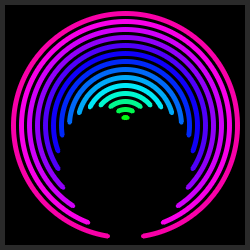
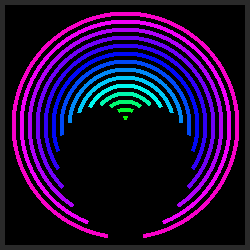
New functions have been added to draw smooth (antialiased) arcs, circles, and rounded rectangle outlines. New sketches are provided in the "Smooth Graphics" examples folder. Arcs can be drawn with or without anti-aliasing (which will then render faster). The arc ends can be straight or rounded. The arc drawing algorithm uses an optimised fixed point sqrt() function to improve performance on processors that do not have a hardware Floating Point Unit (e.g. RP2040). Here are two demo images, on the left smooth (anti-aliased) arcs with rounded ends, the image to the right is the same resolution (grabbed from the same 240x240 TFT) with the smoothing diasbled (no anti-aliasing):
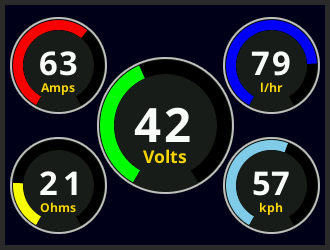
Here the smooth arcs have been used to create anti-aliased meter gauges on a 320x240 TFT:
-
An excellent new compatible library is available which can render TrueType fonts on a TFT screen (or into a sprite). This has been developed by takkaO. The library provides access to compact font files, with fully scaleable anti-aliased glyphs. Left, middle and right justified text can also be printed to the screen. I have added TFT_eSPI specific examples to the OpenFontRender library and tested on RP2040 and ESP32 processors, the ESP8266 does not have sufficient RAM due to the glyph render complexity. Here is a demo screen where a single 12kbyte font file binary was used to render fully anti-aliased glyphs of gradually increasing size on a 320x480 TFT screen:


