


This repo will be updated with more resources in the next few weeks.
-
Fun tools:
-
And more ...
The availability of foundation models has transformed AI from a specialized discipline into a powerful development tool everyone can use. This book covers the end-to-end process of adapting foundation models to solve real-world problems, encompassing tried-and-true techniques from other engineering fields and techniques emerging with foundation models.
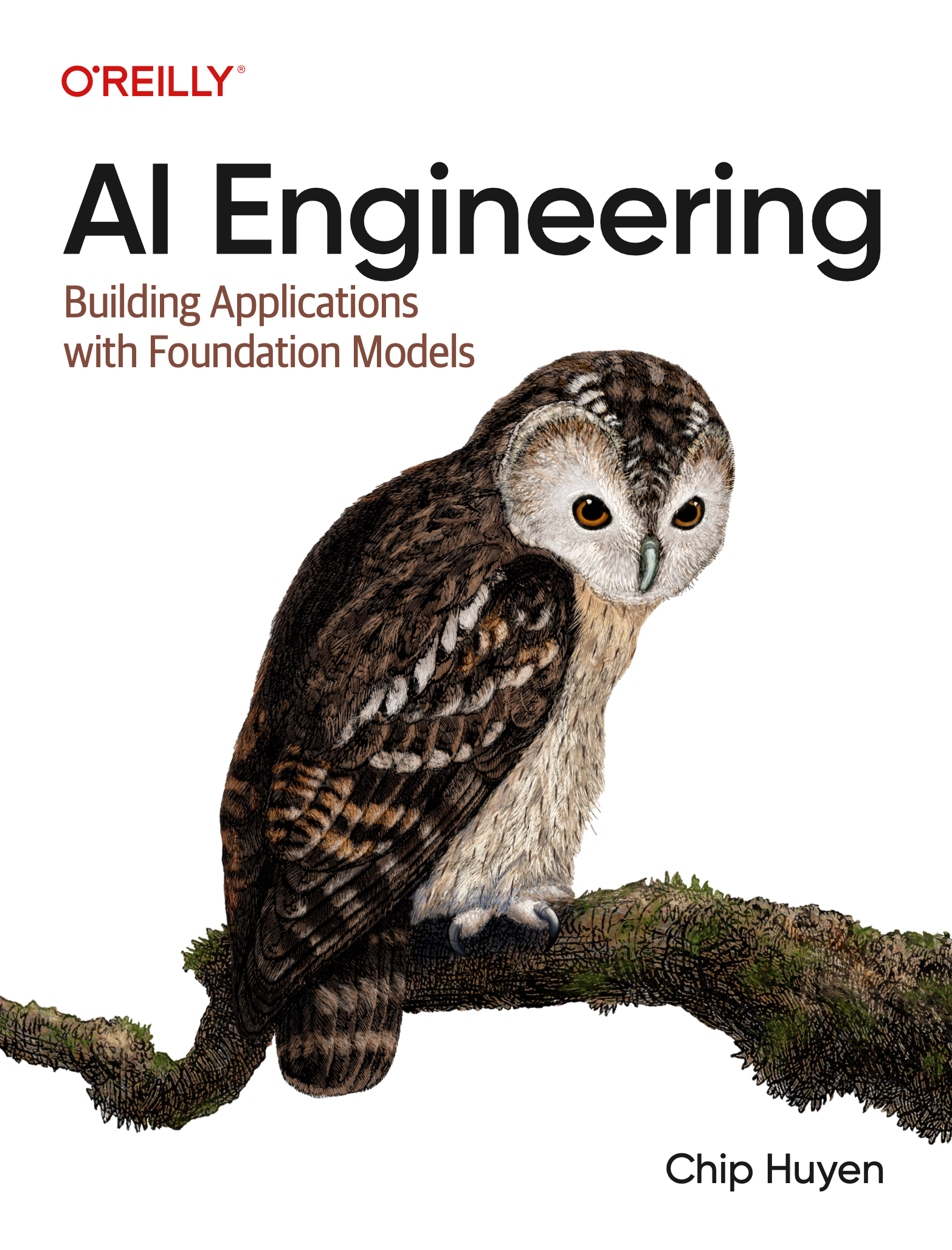
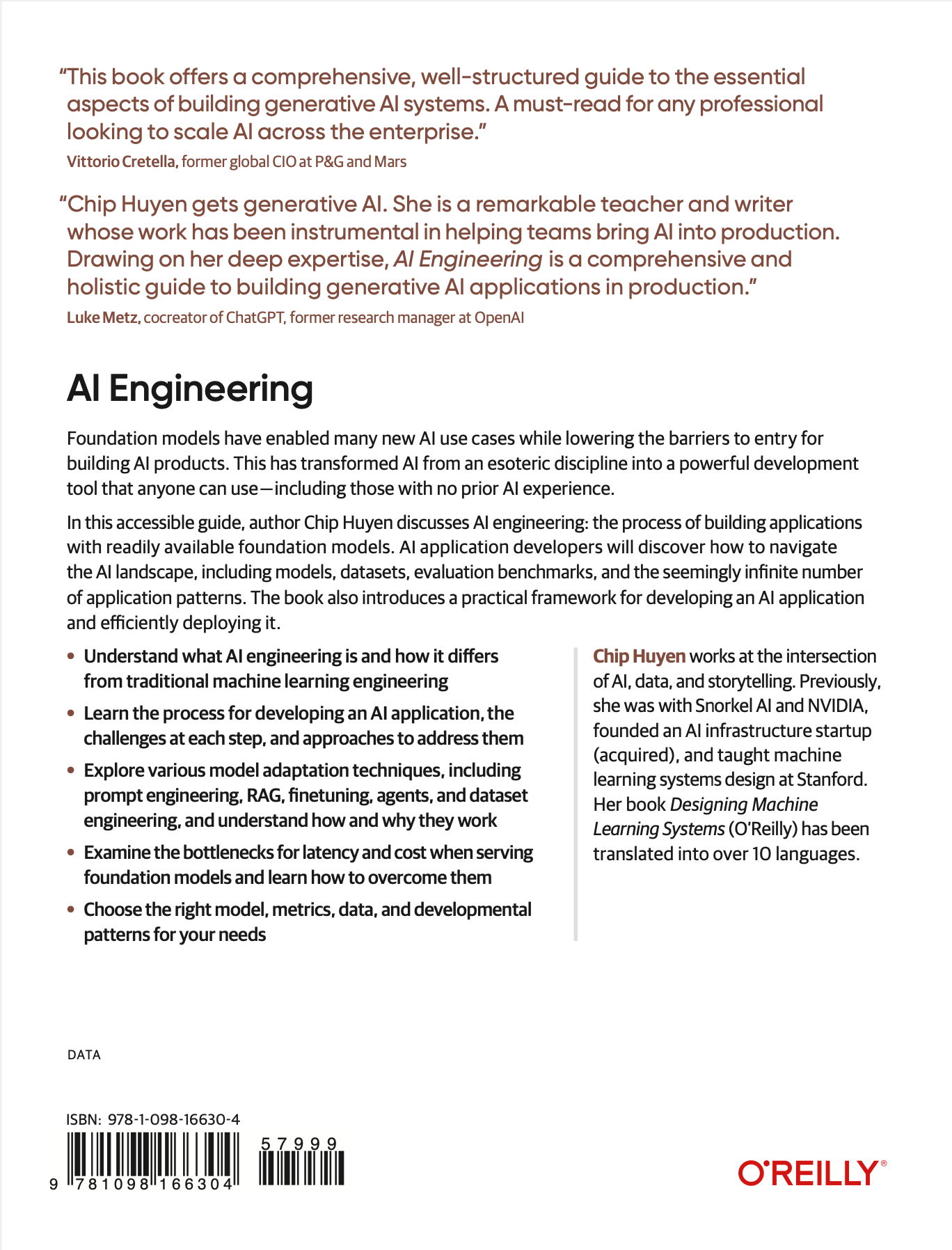
The book is available on:
and most places where technical books are sold.
It's been translated into: Japanese, Korean, Chinese Traditional, Chinese Simplified, Vietnamese, Spanish, Italian, French, Portuguese, German, Thai, Russian, and Polish.
It'll soon be available in Greek, Ukrainian, and Uzbek.
This is NOT a tutorial book, so it doesn't have a lot of code snippets.
This book provides a framework for adapting foundation models, which include both large language models (LLMs) and large multimodal models (LMMs), to specific applications. It not only outlines various solutions for building an AI application but also raises questions you can ask to evaluate the best solution for your needs. Here are just some of the many questions that this book can help you answer:
- Should I build this AI application?
- How do I evaluate my application? Can I use AI to evaluate AI outputs?
- What causes hallucinations? How do I detect and mitigate hallucinations?
- What are the best practices for prompt engineering?
- Why does RAG work? What are the strategies for doing RAG?
- What’s an agent? How do I build and evaluate an agent?
- When to finetune a model? When not to finetune a model?
- How much data do I need? How do I validate the quality of my data?